
Why the numbers matter
Families ask a simple question: are there enough homes for our parents? Counting homes and beds against the number of older people is the usual way to answer it. It is an imperfect measure, but it shows where a country stands. Thailand is ageing fast, with about 13.6 million people aged 60 and over (Time Out Thailand), and it is projected to become “super-aged” in 2031 (Open Development Mekong).
There is no single “right” number
No international body sets a target for the number of homes. The OECD only reports what countries have: an average of 41 long-term care beds per 1,000 people aged 65 and over in 2023 (OECD), or about 4 beds per 100 older people. The range is very wide. In 2019, Luxembourg had 81.6 beds per 1,000 and Greece had 4.1 (OECD). More beds is not automatically better. Sweden, Iceland and Finland each cut facility beds by 15 or more per 1,000 over ten years (OECD).
How Asian countries compare
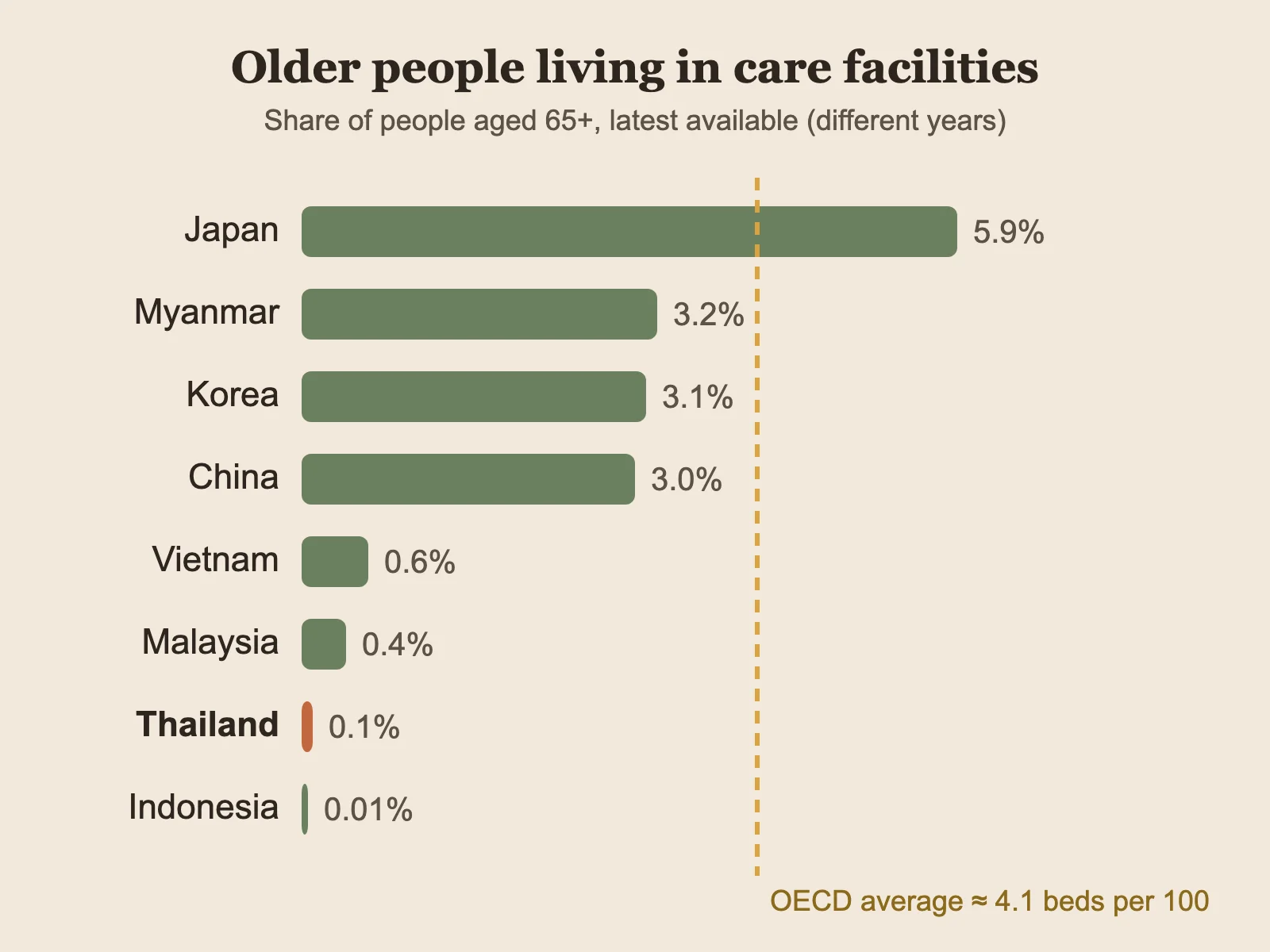
Measured as the share of people aged 65 and over living in care facilities, a regional study found Japan at 5.9%, Myanmar 3.2%, Korea 3.1%, China 3.0%, Vietnam 0.6%, Malaysia 0.4% and Indonesia 0.01%, using data from around 2015 (ERIA). Policy and funding drive these numbers. Korea added about 10 facility beds per 1,000 older people after it introduced public long-term care insurance in 2008 (OECD).
Thailand: what we have today
- Facilities: 1,203 registered facilities were ordered inspected in October 2026 (Nation Thailand). A survey counts nearly 4,000 operating, so almost 70% are unlicensed (Thai PBS World).
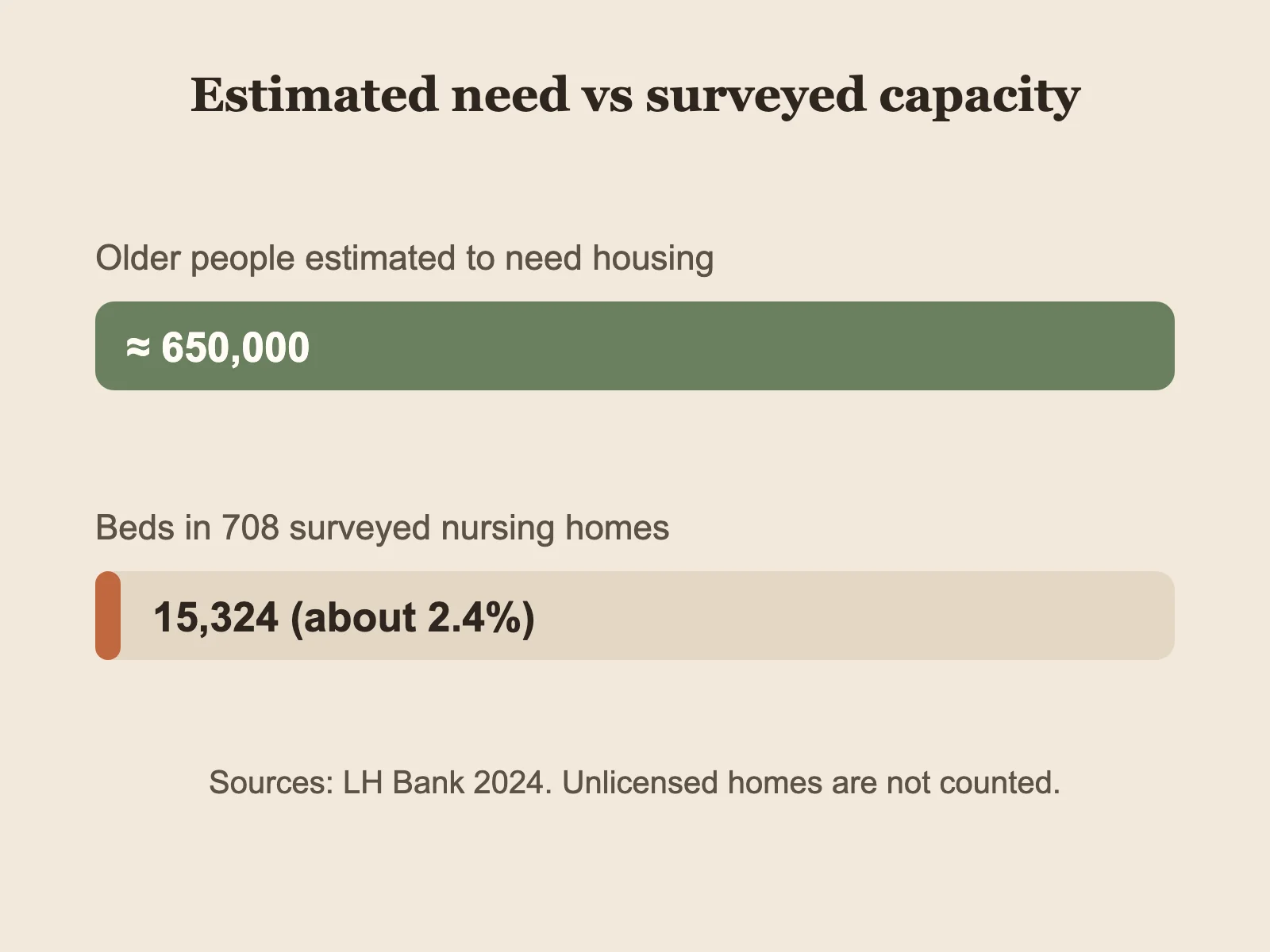
- Capacity: a 2024 LH Bank outlook counted 708 nursing homes with room for 15,324 people and 63.7% occupancy (LH Bank). Against 12.9 million older people, that is about 1.2 beds per 1,000 (our calculation), compared with the OECD average of 41.
- Care needs: around 170,000 older people are bedridden and over 800,000 live with dementia (IBTimes).
Counts differ by source, and unlicensed homes are missing from the capacity figure, so treat these as estimates.
How many might Thailand need?
These are our own illustrations, applied to 13.6 million people aged 60 and over, not official targets.
- 1% in facilities: about 136,000 places, roughly nine times the surveyed capacity.
- 3% (the level of Korea and China): about 408,000 places.
- LH Bank’s estimate: 5% of older people need housing, about 650,000. Surveyed capacity covers about 2.4% of that.
The study ratios are for people aged 65 and over, and many Thai families care at home, so the true need for beds may be lower.
Is the gap really about beds?
Not only. The surveyed homes ran at 63.7% occupancy, and Bangkok’s rate was 69.2% (Bangkok Post). Many beds are empty while families struggle, because price is the barrier. Private homes charge 25,000 to 45,000 baht a month, premium homes 50,000 to 120,000, and small or unlicensed homes 12,000 to 22,000 (Thai PBS World). An MP quoted there said licensed standards are so high that most Thais cannot afford them.
What about retirement homes?
The public figures we found cover nursing homes. We found no reliable national count of retirement (independent-living) communities. They are market-driven housing, so their number follows demand and income more than medical need, and beds per population is a poor yardstick for them.
Our opinion
This section is the view of Nursing Homes Thailand, not established fact.
- The number that matters is affordable, licensed beds with trained staff, not total beds.
- Copying the OECD level of 41 beds per 1,000 is neither realistic nor necessary. A staged target alongside stronger home care looks more sensible.
- Closing unlicensed homes without new capacity could push families toward worse options.
Our suggestions
- Families: decide the level of care first, then compare homes. Ask for the licence and a written fee list, and plan a budget for several years.
- Operators: build licensed homes at the 15,000 to 30,000 baht level, invest in staff training and publish staffing numbers.
- Policymakers: keep a public list of licensed homes, set proportionate standards for small homes, and consider long-term care funding as Korea did.
Interested? Contact us
Not sure what level of care or budget suits your parent? Contact us through Nursing Homes Thailand and we will be glad to help.
Sources
- OECD Health at a Glance 2025: Long-term care settings
- OECD Health at a Glance 2021: Long-term care beds
- OECD Health at a Glance 2023: Long-term care settings
- ERIA: Facility population of older persons in Asia
- LH Bank: SME Industry Outlook 2024, Medical Tourism and Wellness
- Thai PBS World: Caged beds and barred cells (via LINE Today)
- Nation Thailand: Strict checks on 1,203 elderly care facilities
- Bangkok Post: Shortage persists for senior housing
- Time Out Thailand: Thailand is now a nation of grandparents
- IBTimes: Thailand orders 1,203 care facilities inspected