


The short answer
There is no single “best” activity for older adults. The right choice fits the person: what they enjoyed in the past, what they can safely do today, and what they want to gain, such as strength, company or calm. In our view, a good weekly plan mixes three things: moving the body, using the mind, and spending time with other people. Start small, watch how the person responds, and adjust.
Why activities matter
Thailand is now an aged society. As of September 2025, about 14.1 million people, roughly 21.5% of the population, were over 60 (Bangkok Post). WHO estimates that around 1 in 4 older people are socially isolated, and an earlier WHO brief notes that loneliness is even more common among people living in institutions.
In the UK, the NICE quality standard for care homes says residents should be offered meaningful activity during their day that supports their health and mental wellbeing, and should be encouraged to help choose what is meaningful to them. We think the same idea fits Thai homes well.
Step 1: Start with the person, not the timetable
Before choosing an activity, get to know the person. These questions are adapted from the Alzheimer’s Association:
- What do they enjoy? Watch for signs of pleasure, or of worry and irritation.
- What skills remain? A song learned years ago, cooking, sewing or gardening.
- What was their work or hobby? A former office worker may like sorting papers; a former gardener may like watering plants.
- What are the physical limits? Tiredness, poor eyesight or hearing, pain or weak hands.
- Large group or small? Some people feel overwhelmed in a crowd.
NICE also asks care homes to know each resident’s personal history and respect their interests and beliefs. In Thailand, that may include merit-making, chanting or a visit to the temple.
Step 2: Match the activity to ability
Thai health services often screen older adults with the Barthel ADL index, scored out of 20: 12–20 is “socially active” (ติดสังคม), 5–11 is “homebound” (ติดบ้าน) and 0–4 is “bedbound” (ติดเตียง) (Open Government Data of Thailand). These groups are a useful starting point. The examples below are our suggestions, not an official list.
- Socially active (12–20): group exercise, walking groups, dancing, gardening, cooking, volunteering, outings and learning a new skill.
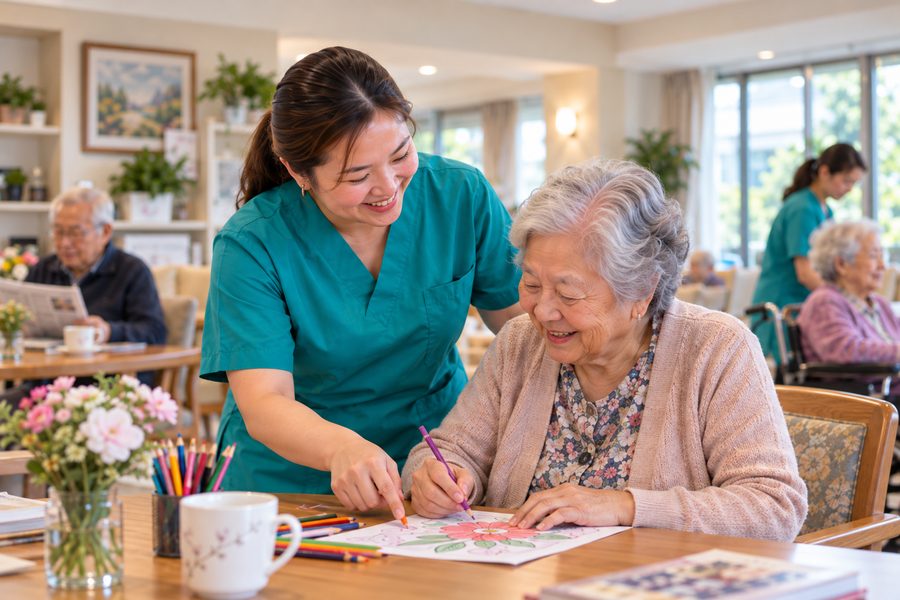
- Homebound (5–11): seated exercise, light hand weights or resistance bands with supervision, colouring, crafts, puzzles, music and small-group games.
- Bedbound (0–4): gentle movement guided by a nurse or physiotherapist, reading aloud, looking at photos, music, hand massage, conversation and time near a window. If you are deciding where a homebound or bedbound relative should live, see Nursing home or a caregiver at home?.
Step 3: Mix body, mind and social time
- Body: WHO recommends at least 150–300 minutes of moderate activity a week for people aged 65 and over, plus varied balance and strength activities on 3 or more days a week to help prevent falls. People who cannot reach this should be as active as their health allows, because some activity is better than none.
- Keep it low-impact: in July 2026, Thailand’s Department of Health encouraged older people to join the popular park aerobics trend, but to adapt the moves: less jumping, more marching, side steps and arm swings, at a pace where they can still talk (Hfocus).
- Mind: reading, word games, colouring, crafts, music and learning something new.
- Social: group activities, shared meals, family visits and video calls.
If the person lives with dementia
The Alzheimer’s Association suggests:
- Focus on enjoyment, not the finished result.
- Show how to start, and break the task into simple steps.
- Do the hard parts yourself and give the person a clear, simple role.
- Do not force or correct. Refusal may mean the task feels too hard or frightening.
- Pick the right time of day, stop when attention fades, and try again later.
- Help the person feel needed, for example: “Could you help me fold these towels?”
If you notice new changes in mood, sleep or behaviour, our guide to recognising mental health signs in an elderly parent can help you decide what kind of care is needed.
Safety first
- Check with a doctor first if the person has not exercised for some time or has medical conditions, and make sure the intensity suits their fitness (NHS).
- Use stable chairs with armrests, keep water nearby, and keep staff close at hand.
- In our view, stop and tell the nurse straight away if the person has chest pain, dizziness, unusual breathlessness or new pain.
- Thailand’s Department of Disease Control advises nursing homes to investigate the cause of every fall and fix the risk point each time.
Our opinion
This section is the view of Nursing Homes Thailand, not established fact.
- The best activity is the one the person wants to do. A full timetable means little if residents only sit and watch.
- Activities are part of care, not an extra. They deserve trained staff, time and a budget. Read more about the roles of NA, CG, PN and RN staff and training beyond the 420-hour course.
- Bedbound residents are often left out. They need one-to-one time, even 10–15 minutes a day.
- Families are part of the team. A visit spent doing something together is often worth more than a gift.
Our suggestions
- Families: share your relative’s life story, hobbies, favourite songs and foods with the home. Ask to see the weekly activity schedule, and ask what bedbound residents do each day.
- Operators: assess each resident’s interests and ADL on admission, plan activities for each group, record who takes part, and review the plan every few months.
- Caregivers: offer choices, go at the person’s pace, and note what makes them smile.
- When visiting a home: go during activity time and see whether residents are joining in or just watching. For more questions to ask, see what families should know before choosing a care facility.
Interested? Contact us
Not sure whether a home offers activities that suit your loved one? Contact us through Nursing Homes Thailand and we will be glad to help.
Related reading
- Nursing homes in Thailand: a family’s guide to elder-care centres
- Nursing Home or a Caregiver at Home? How to Know When It Is Time
- NA, CG, PN and RN in a Nursing Home: What Is the Difference?
- Should Caregivers and Nurses Be Trained Beyond the 420-Hour Course?
- Nursing Home or Psychiatric Hospital? Recognising Mental Health Signs in an Elderly Parent
- When Trust Is Shaken: What Families Should Know Before Choosing an Elderly Care Facility
Sources
- Bangkok Post (via Magzter): Thailand taps into silver workforce
- WHO: Reducing social isolation and loneliness among older people
- WHO: Advocacy brief on social isolation and loneliness among older people
- NICE QS50: Mental wellbeing of older people in care homes
- Alzheimer’s Association: Activities
- Open Government Data of Thailand: ADL screening of older people
- WHO: Guidelines on physical activity and sedentary behaviour
- Hfocus: Department of Health invites older people to try low-impact aerobics
- NHS: Physical activity guidelines for older adults
- Department of Disease Control: Fall prevention in nursing homes