


The short answer
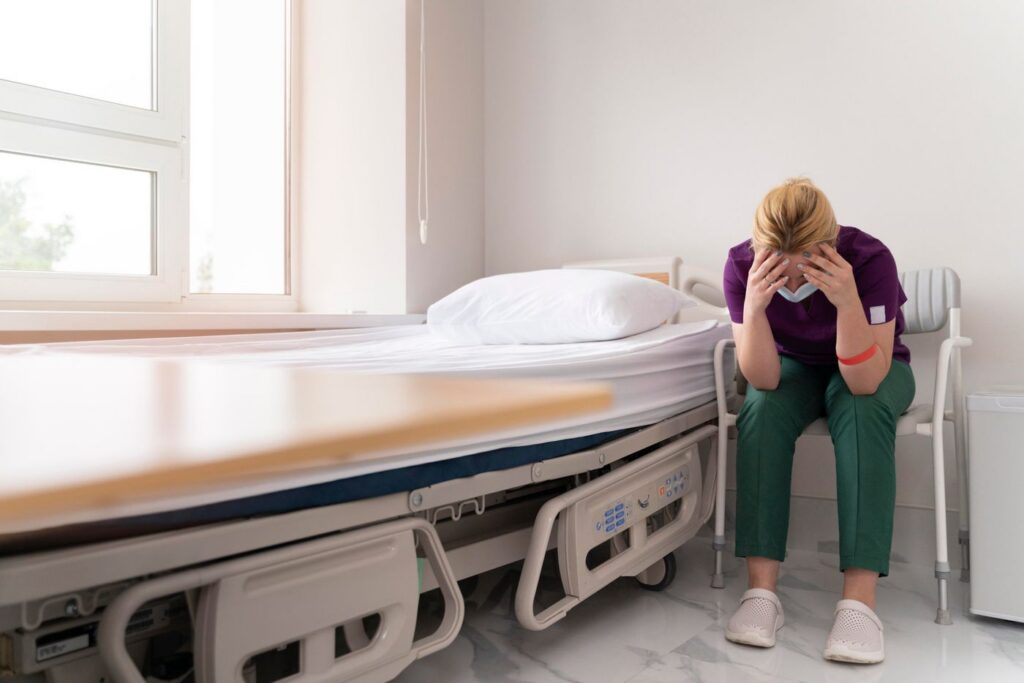
Caregiver burnout is a state of physical, emotional and mental exhaustion that can build up when someone gives most of their time and energy to looking after another person’s health and safety (Cleveland Clinic). It affects family members caring at home and paid staff such as caregivers (CG), nursing assistants (NA) and practical nurses (PN) in nursing homes (see what NA, CG, PN and RN staff do). It is common: Cleveland Clinic notes that studies show more than 60% of caregivers have symptoms of burnout. The good news is that it can be spotted early, and it can be prevented and treated, especially when the caregiver is not left to cope alone.
What is caregiver burnout?
The World Health Organization lists burn-out in ICD-11 (code QD85) as an occupational phenomenon, not a medical condition. It describes it as the result of long-term workplace stress that has not been managed successfully (Becker’s Hospital Review). It has three parts:
- Exhaustion: feeling drained of energy.
- Mental distance: feeling negative or cynical about the work, or cut off from it.
- Reduced effectiveness: feeling less able to do the job well.
WHO uses the word only for work, so it fits paid caregivers in nursing homes directly. For family caregivers, doctors use “caregiver burnout” to describe the same kind of exhaustion at home.
Stress or burnout? Stress usually feels like too much: too many tasks, too much pressure. Burnout feels like not enough: not enough energy, motivation or care left to give (Flint Rehab). It does not happen overnight. It builds up over weeks or months.
How do we notice it? The warning signs
The signs look a lot like stress and depression, and many caregivers do not notice them in themselves (Cleveland Clinic). Watch for:
- Body: tiredness that sleep does not fix, sleeping too much or too little, gaining or losing weight, frequent headaches or body aches, getting sick more often.
- Mood: feeling burdened or worried all the time, being easily irritated or angry, feeling hopeless or helpless (Mayo Clinic).
- Behaviour: pulling away from friends and family, losing interest in things once enjoyed, missing your own medical appointments, using alcohol or drugs, including prescription medicines, to cope.
- At work: more small mistakes, trouble concentrating, and feeling resentment toward the person being cared for. Cleveland Clinic advises getting help straight away if that resentment appears.
For families visiting a nursing home, possible signs that staff are stretched include the same few people always on shift and looking exhausted, many new faces, short or impatient replies, and residents waiting a long time for help. These are our observations, not a diagnosis. They are a reason to ask the home questions, not to blame individual caregivers.
Why does it happen?
- Long-term stress without rest: caring every day for weeks or months with no one to take over (Cleveland Clinic).
- No support system, and feeling that you are the only one who can do the job.
- Role confusion: a family caregiver may find it hard to separate being a caregiver from being a son, daughter or spouse.
- Lack of control: watching a loved one decline even when you do everything you can.
- Working conditions: a Thai study of 375 long-term care managers in Health Region 9 (Nakhon Ratchasima, Buriram, Surin and Chaiyaphum) found that 29.3% had high emotional exhaustion. Burnout was linked to workload, income adequacy, rest time, family time, benefits, support from the organisation and job satisfaction (Regional Health Promotion Center 9 Journal).
Thai PBS Policy Watch describes family caregivers as a silent crisis in hundreds of thousands of Thai homes, people who give up income and their own plans to care for bedridden or dependent relatives without enough welfare support.
The impact
On the caregiver. Burnout can affect a person physically, psychologically, financially and socially (Cleveland Clinic). Too little sleep, too little exercise and a poor diet raise the risk of conditions such as heart disease and diabetes (Mayo Clinic). In rare, severe cases, the stress and depression that come with burnout can be life-threatening.
On the person receiving care. Burnout can lower the quality of care a caregiver is able to give. In care homes, higher staff burnout has been associated with lower quality care and with abusive or neglectful behaviour (Age and Ageing, MARQUE study). A US study of 245 nursing homes found that homes with good work environments had 1.8% fewer residents with pressure ulcers and 16 fewer hospital admissions per 100 residents a year than homes with poor environments (PubMed).
On the nursing home. Burnout is often linked to staff leaving. A JAMA Internal Medicine study of 13,826 US nursing homes found that higher nursing staff turnover was linked to more inspection citations and worse quality scores, including more residents whose mobility and daily activities got worse (TechTarget).
The evidence is not all one way. A study of 2,062 care staff in England found that burnout was low on average, although nearly a third of staff had high burnout, and it found no link between burnout and staff turnover at home level (Age and Ageing, MARQUE study). A study of about 90 nursing homes found no link between care aide burnout and several resident outcomes (McKnight’s). Burnout does not automatically mean poor care, but it is a risk that good homes take seriously.
How to prevent and solve it
For caregivers:
- Ask for and accept help. You do not have to do everything yourself (Mayo Clinic).
- Focus on what you can do, and set small goals you can reach.
- Take regular breaks, and use respite care, a short break while someone else takes over (Cleveland Clinic).
- Protect the basics: sleep, regular meals, some movement, and your own doctor’s appointments.
- Talk about it with someone you trust, a support group or a health professional. A Thammasat University study of 60 caregivers of bedridden patients found that a social support programme reduced burnout.
- Learn practical skills. Mahidol University’s Faculty of Physical Therapy created a Caregiving Manual for Caregivers (CMC) to help reduce caregiver fatigue (Naewna).
For families:
- Share the load: set up a rota among relatives, even for a few hours a week.
- Use outside help: day care, short-stay respite or a nursing home when home care is no longer sustainable. Choosing professional care is not giving up. Our guide Nursing home or a caregiver at home? can help you decide when it is time, and how much a nursing home costs in Thailand can help you plan.
- Check in on the main caregiver and say thank you.
For nursing home operators:
- Safe staffing on every shift, including nights, with fair rotas and real days off.
- Fair pay and benefits, and a clear path to grow.
- Support after hard days: short team debriefs after events such as a resident’s death, and access to counselling.
- Training that builds confidence, for example in dementia care and safe transfers. See why training beyond the 420-hour course matters.
- Check staff wellbeing regularly, for example with a short anonymous survey.
When to get help right away
If the signs last more than two weeks, or you feel hopeless, think about harming yourself, or worry that you might hurt the person you care for, get help now. In Thailand, call the Department of Mental Health hotline 1323 (Bangkok Biz News), or 1669 in a medical emergency. You can also speak to a doctor at your local hospital or health centre.
Our opinion
This section is the view of Nursing Homes Thailand, not established fact.
- Caregiver burnout is mostly a system problem, not a personal weakness. Telling a tired caregiver to “do more self-care” does not help if they work double shifts.
- A home that looks after its staff is more likely to look after its residents. How a home treats its staff should be part of how families judge it.
- Family caregivers in Thailand need more recognition and practical support, such as affordable respite services.
Our suggestions: questions families can ask a home
- How many residents does each caregiver look after, by day and by night?
- How long are shifts, and how many days off do staff get?
- How long have most of your caregivers worked here?
- What support do staff get after a difficult event?
- What training do staff receive each year?
For more questions to ask, see what families should know before choosing a care facility.
Interested? Contact us
Caring for someone and feeling worn out? Or looking for a home that treats its staff well? Contact Nursing Homes Thailand and we will be glad to help.
Related reading
- Nursing Home or a Caregiver at Home? How to Know When It Is Time
- NA, CG, PN and RN in a Nursing Home: What Is the Difference?
- Should Caregivers and Nurses Be Trained Beyond the 420-Hour Course? BLS, First Aid and More
- When Trust Is Shaken: What Families Should Know Before Choosing an Elderly Care Facility
- How Much Does a Nursing Home Cost in Thailand? (2026)
- Nursing homes in Thailand: a family’s guide to elder-care centres
Sources
- Cleveland Clinic: Caregiver burnout
- Mayo Clinic: Caregiver stress, tips for taking care of yourself
- Becker’s Hospital Review: WHO recognises burnout as an occupational phenomenon (ICD-11)
- Flint Rehab: How to prevent and overcome caregiver burnout
- Regional Health Promotion Center 9 Journal: Burnout among long-term care managers in Health Region 9
- Thai PBS Policy Watch: Family caregivers in Thailand
- Age and Ageing (PMC): Burnout in UK care home staff, MARQUE study
- PubMed: Work environment, nurse burnout and care quality in nursing homes
- TechTarget: Nursing home staff turnover and care quality (JAMA Internal Medicine)
- McKnight’s: Care aide burnout and resident outcomes
- Thammasat University: Social support programme and burnout in caregivers of bedridden patients
- Journal of Public Health and Innovation: Burnout self-care among caregivers in Nakhon Si Thammarat
- Naewna: Mahidol University caregiving manual to reduce caregiver fatigue
- Bangkok Biz News: Department of Mental Health hotline 1323